
Rabbit Kindling: What Can Go Right, What Can Go Wrong
While we always hope the birthing process will be smooth for our mothers-to-be, we know that this isn't always the case. Read about the challenges of rabbit kindling.
Amy Jackson & The Hot Cross Buns
10/23/20244 min read
Kindling: What Can Go Right, and What Can Go Wrong
When New Life Begins
There is a quiet assumption that rabbits give birth easily and raise their young without difficulty.
That may be true in some situations, but it is not something we take for granted, especially with Holland Lops. Their size, structure, and individual temperament can make kindling and early care more delicate than many people expect.
When everything goes well, it is simple and beautiful.
A doe prepares a nest lined with soft hay and fur pulled from her own chest. She kindles quickly, cleans each kit, and tucks them safely into the warmth she has created. In the days that follow, she returns to feed them, keeping them clean, warm, and protected until they begin to explore the world on their own.
It is an absolute joy to witness.
And yet, it does not always unfold this way.
Nest Building: The First Sign of Readiness
Nest building is often the first indication that a doe is preparing for her babies.
Many will begin several days before kindling, carrying mouthfuls of hay and carefully arranging them into a nest. We have learned to wait until a doe shows clear signs that she is ready. Offering a nest box too early often results in it being used as a litter box rather than a nursery.
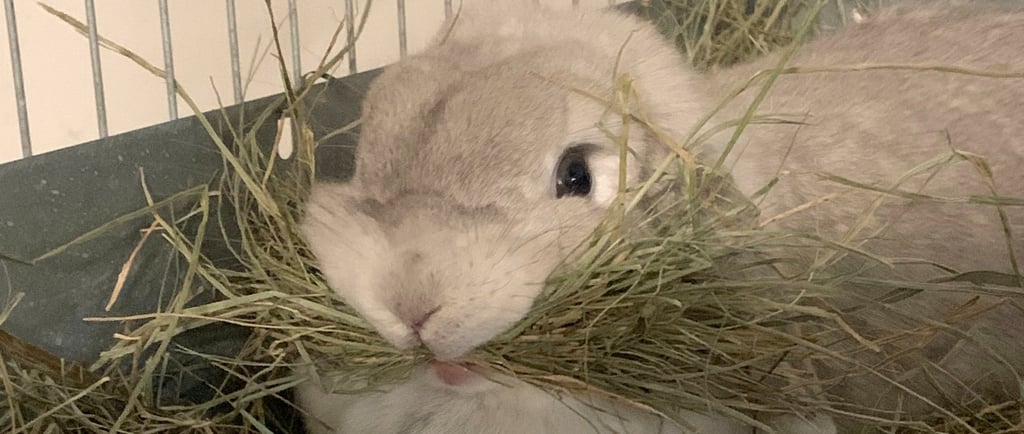
When a doe begins what we affectionately call the “haystache,” gathering and transporting hay with purpose, it is clear that she is ready to build. Watching her work is something remarkable. She shapes and adjusts the nest with care, testing and refining it until it meets her standards.
Once finished, she often rests, as though satisfied that everything is in place.
When Nesting Does Not Go as Planned
Not all does follow that pattern.
Some refuse to use a nest box at all. Others build a beautiful nest, only to abandon it when labor begins. A few wait until the last moment and create only a minimal nest, offering little protection.
When kits are born outside of a proper nest, they are immediately vulnerable. Without the warmth of fur and the cushioning of hay, they can become chilled very quickly. They are also at risk of injury during birth.
Even when intervention is possible, not all kits recover from these early challenges.
The Kindling Process Itself
Kindling is typically quick.
In an ideal situation, the entire process is completed within twenty to thirty minutes. When it extends beyond that, concern begins to rise.
A kit may become stuck, either due to size or position. When this happens, the remaining kits may not survive the delay. This is particularly common in first-time dwarf does, where size can work against them.
Even when part of the litter is born successfully, it is not unusual to later find stillborn kits, hours or even a day or two after the initial kindling.
Early Care: When Instinct Isn’t Enough
Once the kits are born, their survival depends on warmth, feeding, and appropriate maternal care.
Most does clean their babies and move on quickly. Occasionally, a doe may over-groom, using her teeth instead of just her tongue. This can result in serious injury. In some cases, kits may not survive this behavior.
We have seen both outcomes. Some injured kits have gone on to live full and happy lives, but more often, the damage is too great.
When this behavior appears, it's not something we ignore. It informs our decisions about that doe’s future.
Warmth and Protection
After cleaning her kits, a doe should cover them with fur to insulate them.
Some pull very little fur, leaving the kits exposed to cold. Others pull excessive amounts. A balance is needed.
When additional warmth is required, we supplement carefully, ensuring that any added fiber is safe and does not pose a risk of tangling around the kits.
Warmth in these early days is not optional, but essential for survival.
Feeding and Early Intervention
Healthy kits should have full, rounded bellies after feeding.
Most does nurse their litters once or twice a day without assistance. Occasionally, a doe may be slow to begin, or unsure as a first-time mother.
In these cases, gentle intervention can help. Creating a quiet, enclosed space encourages the doe to relax and allows the kits to nurse successfully. Often, this support is only needed briefly before the natural rhythm establishes itself.
Some does have especially thick coats and the babies have a difficult time finding a teat at which to suckle. We step in and carefully shave around each one, giving the babies a chance at survival.
Another risk occurs when a doe leaves the nest too quickly during feeding, unintentionally carrying a kit with her. A displaced kit must be returned promptly and kept warm to survive.
The First Week: A Critical Window
If a litter makes it through kindling and the first week of life, their chances improve significantly.
There are still risks—milk supply issues, mastitis, or unexpected changes—but the most fragile period has passed.
Each day becomes a little more stable, and a little more hopeful.
Why Every Litter Matters
After seeing how much can go wrong, it becomes impossible to take any successful litter for granted.
Each kit that grows, each doe that cares well for her young, and each smooth kindling feels like something to be deeply appreciated.
These are not routine moments, but small, quiet miracles.
________________________________________________________________________________________________________________
Following the Journey: From Kindling to Placement
The early weeks of a rabbit’s life unfold quickly, with each stage building on the one before it. If you would like to follow that progression more closely, these posts walk through the process from birth through placement day.
• Rabbit Kindling: What Can Go Right, What Can Go Wrong
• A Rabbit's First Week of Life
• A Rabbit's Second Week of Life
• A Rabbit's Third Week of Life
• A Rabbit's Fourth Week of Life
• A Rabbit's Fifth Week of Life
• A Rabbit's Sixth Week of Life
• A Rabbit's Seventh Week of Life
• Placement Day: What to Expect When You Bring Your Bun Home
Taken together, they offer a complete picture of how rabbits grow, develop, and prepare for life with their new families.
Copyright 2016-present. All rights reserved by Hot Cross Buns Holland Lops. All images and content fall under the sole ownership of Hot Cross Buns Holland Lops.
Hot Cross Buns Holland Lops
Oberlin, Ohio
Indoor companion Holland Lops raised with care since 2016.
Email: hcbhollands@gmail.com