
A Rabbit's First Week of Life
A rabbit's first week of life is delicate and fast-changing. Learn what to expect, including feeding, warmth, development, and early care provided by the mother.
Amy Jackson & The Hot Cross Buns
10/30/20244 min read
The First Week of Life: What to Expect With Newborn Rabbit Kits
When Everything Begins
If a baby rabbit survives the birth process, is born into a warm, well-prepared nest, and has a healthy, attentive mother, the chances of doing well are strong.
Even so, the first week of life is delicate.
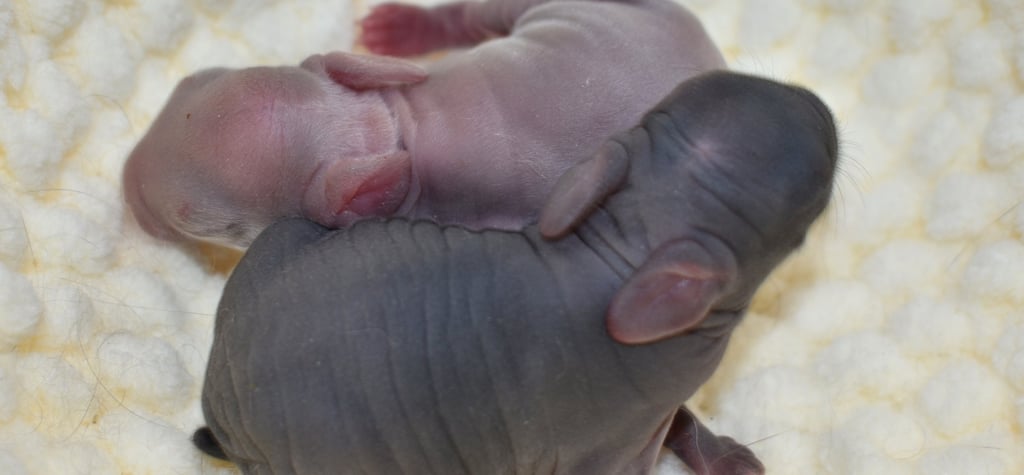
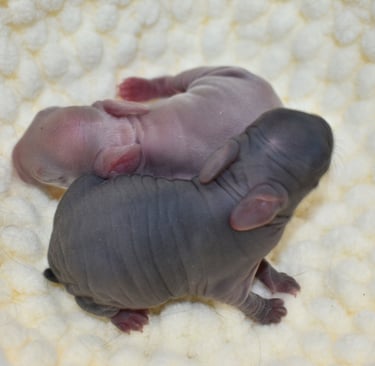
Newborn kits are furless, blind, and deaf. They are completely dependent on their mother and their environment for survival. At birth, they resemble tiny hippopotami more than rabbits, but that changes quickly as the days pass.
A Brief Window for Early Observations
In the first day of life, there is a very short window where it is sometimes possible to identify the gender of each kit.
The physical differences are subtle and fleeting. A baby buck has two separate circular openings, while a baby doe has a slit above a round opening. This area is more visible immediately after birth due to swelling, but becomes less defined within a day or two.
Because of how small and fragile the kits are, we do not routinely check gender at this stage. After the first couple of days, determining gender requires applying pressure to the area, which can risk injury. For that reason, we wait until they are older and stronger before confirming.
Feeding and the Role of the Mother
Newborn kits rely entirely on their mother for nourishment.
Rabbits nurse quickly, and in just a few moments, kits are able to take in enough milk to sustain them until the next feeding. Because of this, it is easy to assume nothing is happening when, in reality, everything is working as it should.
There is one important risk during feeding.
If a doe becomes startled and leaves the nest box while her kits are still latched, a baby may be carried along with her. Unlike dogs or cats, rabbits cannot pick up and return their young. A displaced kit depends entirely on being found quickly and returned to the warmth of the nest.
To help protect against this, we keep soft, layers of material beneath the nesting area. If a baby is pulled from the nest, it has a chance to stay warm until we are able to return it.
Small Voices in a Quiet Space
Adult rabbits are generally quiet animals, but newborn kits can be surprisingly vocal.
When they are hungry, they make soft, guinea pig-like sounds. When several kits vocalize together, it creates a gentle chorus that is both endearing and informative.
These sounds tell us something important.
They often indicate that the mother has not yet fed them, and allows us to be more attentive during those early days.
The Importance of Warmth
During the first week, kits are unable to regulate their own body temperature.
They rely on their littermates, the structure of the nest, and the fur their mother pulls to stay warm. Without these elements, their chances of survival decrease quickly.
In situations where a kit is a singleton, additional support may be necessary. We have used heating pads, warm water bottles, and even simple methods like a warmed object to help maintain body temperature.
Whenever possible, fostering a single kit into another litter provides the best outcome. Being surrounded by littermates offers a level of warmth and stability that is difficult to replicate.
Fostering and Scent Recognition
If a kit needs to be fostered into another litter, scent plays a critical role.
A doe recognizes her babies by scent, and introducing a new kit without addressing that can lead to rejection. In some cases, it can disrupt care for the entire litter.
To help prevent this, we lightly mask scent by placing a small amount of vanilla extract on the foster kit, the existing litter, and the mother’s nose. This helps blend their scent and allows the doe to accept the new baby as her own.
When done carefully, fostering can be seamless.
Growth, Change, and the “Popcorn” Stage
As the week progresses, changes become more noticeable.
Kits grow quickly. Fur begins to come in, and their coloring starts to emerge. They become stronger, and while they still spend most of their time sleeping, their reflexes begin to develop.
During this stage, they may suddenly jerk or spring in response to touch, light, or temperature changes. We often refer to this as the “popcorn” stage, as their movements resemble small kernels popping unexpectedly.
These reactions are part of normal neurological development as their bodies begin to respond to the world around them.
Early Care and Natural Processes
The mother plays an essential role beyond feeding.
She stimulates her kits to urinate and defecate through grooming. As they grow, they may become damp from this process, especially when well-fed and hydrated.
While it can be messy, it is a sign that things are working as they should.
Watching Them Become Themselves
The first week begins slowly, but each day brings visible change.
Kits become more defined, more responsive, and more recognizable as the rabbits they will become. Even at this early stage, small hints of personality begin to appear.
It is a quiet, remarkable process to witness.
A Week That Requires Attention and Patience
The first week of life is not complicated, but it is sensitive.
Warmth, feeding, and observation are the foundations of success. When those needs are met, many kits go on to grow and thrive.
It's not a time to interfere unnecessarily, but it is a time to pay close attention.
________________________________________________________________________________________________________________
Following the Journey: From Kindling to Placement
The early weeks of a rabbit’s life unfold quickly, with each stage building on the one before it. If you would like to follow that progression more closely, these posts walk through the process from birth through placement day.
• Rabbit Kindling: What Can Go Right, What Can Go Wrong
• A Rabbit's First Week of Life
• A Rabbit's Second Week of Life
• A Rabbit's Third Week of Life
• A Rabbit's Fourth Week of Life
• A Rabbit's Fifth Week of Life
• A Rabbit's Sixth Week of Life
• A Rabbit's Seventh Week of Life
• Placement Day: What to Expect When You Bring Your Bun Home
Taken together, they offer a complete picture of how rabbits grow, develop, and prepare for life with their new families.
Copyright 2016-present. All rights reserved by Hot Cross Buns Holland Lops. All images and content fall under the sole ownership of Hot Cross Buns Holland Lops.
Hot Cross Buns Holland Lops
Oberlin, Ohio
Indoor companion Holland Lops raised with care since 2016.
Email: hcbhollands@gmail.com