
Help! My Rabbit Just Had Babies—What Do I Do?
My rabbit just had babies unexpectedly. What to Do If Your Rabbit Has Babies Unexpectedly - Learn exactly what to do, including warming cold kits safely, helping the mother nurse, setting up a proper nest, and preventing another accidental litter.
Amy Jackson & The Hot Cross Buns
4/14/20264 min read
Help! My Rabbit Just Had Babies—What Do I Do?
If you just discovered a litter of baby rabbits and weren’t expecting it, you are not alone.
This happens more often than people realize.
Rabbits are frequently mis-sexed, especially when they are young. Many people bring home what they believe are two females or two males, only to discover later that they have one of each. Others add a second rabbit before the first has been spayed or neutered, assuming they are the same gender.
And then one day, there are babies.
Take a breath. Start here.
🚨 If the babies are cold or not moving (read this first)
Cold kits can sometimes be revived if they are warmed slowly and carefully.
Place each baby in a separate zip-top bag. Gently blow air into the bag before sealing it so there is a cushion of air around the baby.
Fill a bowl with warm water at approximately 103°F (39–40°C). Place the sealed bags in the water and allow them to float.
This allows the babies to warm gradually without getting wet.
Maintain the water temperature around 103°F
Add warm water as needed to keep it stable
Watch closely for any signs of movement
If there is no response after about 30 minutes, the baby has likely not survived.
If a baby begins to move, kick, or squirm:
remove the bag from the water
take the baby out and dry completely
return the baby to the nest with the others
Warmth comes first.
First: check on the babies
Rabbits do not behave like dogs or cats after giving birth.
A mother rabbit will not stay with her babies constantly. In fact, she will only nurse them once or twice a day, usually for just a few minutes in the early morning and evening.
This means:
It is normal for the babies to be alone most of the time
It is normal for the nest to look unattended
What you are looking for is:
babies that are warm
babies that are grouped together
babies with round, full bellies
Make sure the mother has a proper nest
The mother should have:
a quiet, secure space
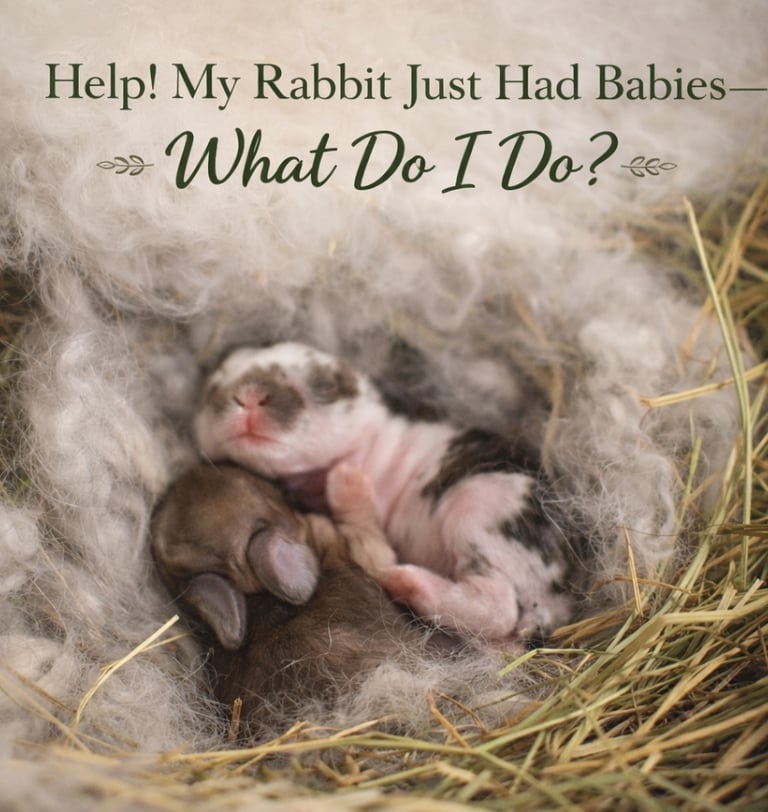
a nest made of hay and fur
protection from disturbance
If she did not create a nest, you can make one.
Use a small, sturdy container, such as:
a cardboard box
a plastic storage bin
a dishpan
It should be:
large enough for the mother to hop in and turn around
small enough to keep the babies together
Line it with a thick layer of hay and create a shallow hollow.
If the mother has pulled fur, line the hollow with it and lightly cover the babies.
If she has not pulled fur, you can try gently brushing her, especially along the chest, to stimulate that instinct.
Keep the babies covered to retain warmth.
Helping the mother recognize and care for the babies
Sometimes a young or overwhelmed doe does not immediately respond to her litter.
If needed, you can:
gently place a moving baby near her
allow her to see and smell the kit
This can help trigger maternal behavior.
If the mother is not nursing
It is normal not to see nursing happen.
However, if you are confident the babies are not being fed, you can intervene carefully.
Place the nest box on a surface where the mother cannot easily leave, such as a small table or counter. Put the mother into the box and cover the nest box with towels.
This creates a dark, enclosed space similar to a burrow.
keep her gently contained
you can softly pet her head to help her relax
do not allow her to jump out
When relaxed, she will often position herself over the nest and allow the babies to nurse underneath her. Sometimes you can hear them sucking and swallowing.
You may need to repeat this for 2–3 feedings. After that, many mothers begin caring for the litter on their own.
Do not attempt to syringe feed newborn kits
Newborn rabbits are extremely fragile.
They can easily aspirate (inhale liquid into the lungs) if syringe feeding is attempted.
The safest option is always to:
encourage the mother to nurse
support her in doing so
Separate the male immediately
If the father is still with the mother, he must be removed right away.
A female rabbit can become pregnant again within hours after giving birth.
Male rabbits (bucks) can also be very territorial and may harm the young.
Feed the mother well
The mother now needs more energy than usual.
Make sure she has:
unlimited hay
fresh water
her normal pellets
Pay attention to the mother’s condition
If the mother is very young (under five to six months), or if the birth was difficult, she may need veterinary care.
Watch for:
lethargy
lack of appetite
signs of pain
complete lack of interest in the babies
What comes next
Over the next days and weeks:
eyes open around 10 days
babies begin leaving the nest around 2–3 weeks
Your role is to:
keep them warm
keep the environment clean
check daily, and interact gently within the mother's sight
Prevent this from happening again
Once things are stable:
separate all rabbits by sex when the babies are weaned (6–8 weeks)
confirm gender accurately
Plan ahead:
neuter the adult buck (he remains fertile for 6–8 weeks after surgery, so he must stay separated)
spay the mother after weaning
She will need 2–3 months to recover fully and for hormones to settle. After that, slow, careful introductions can be made if you plan to house them together again.
_____________________________________________
Following the Journey: From Kindling to Placement
The early weeks of a rabbit’s life unfold quickly, with each stage building on the one before it. If you would like to follow that progression more closely, these posts walk through the process from birth through the seventh week of life.
• Rabbit Kindling: What Can Go Right, What Can Go Wrong
• A Rabbit's First Week of Life
• A Rabbit's Second Week of Life
• A Rabbit's Third Week of Life
• A Rabbit's Fourth Week of Life
• A Rabbit's Fifth Week of Life
• A Rabbit's Sixth Week of Life
• A Rabbit's Seventh Week of Life
Copyright 2016-present. All rights reserved by Hot Cross Buns Holland Lops. All images and content fall under the sole ownership of Hot Cross Buns Holland Lops.
Hot Cross Buns Holland Lops
Oberlin, Ohio
Indoor companion Holland Lops raised with care since 2016.
Email: hcbhollands@gmail.com