What a Healthy Rabbit Should Look Like
Wondering what a healthy rabbit should look like? Learn the subtle, real-life signs of rabbit health, from behavior and posture to appetite and coat condition, so you can recognize what’s normal and what’s not.
Amy Jackson & The Hot Cross Buns
4/11/20263 min read
What a Healthy Rabbit Should Look Like
There is a moment that happens quietly, usually when everything is just… right.
A rabbit settles into its space, stretches out, maybe tucks its feet beneath its body, and simply rests. Its breathing is soft. Its eyes are clear. Nothing feels urgent or off. If you spend enough time around rabbits, you begin to recognize this as one of the most reliable healthy rabbit signs there is.
Health in rabbits is rarely loud or obvious. It shows up in small, consistent ways that are easy to overlook if you're not used to watching for them.
What a Healthy Rabbit Looks Like Day to Day
Most people expect health to look active or energetic all the time. In reality, a healthy rabbit moves through a range of quiet, steady behaviors.
You may notice:
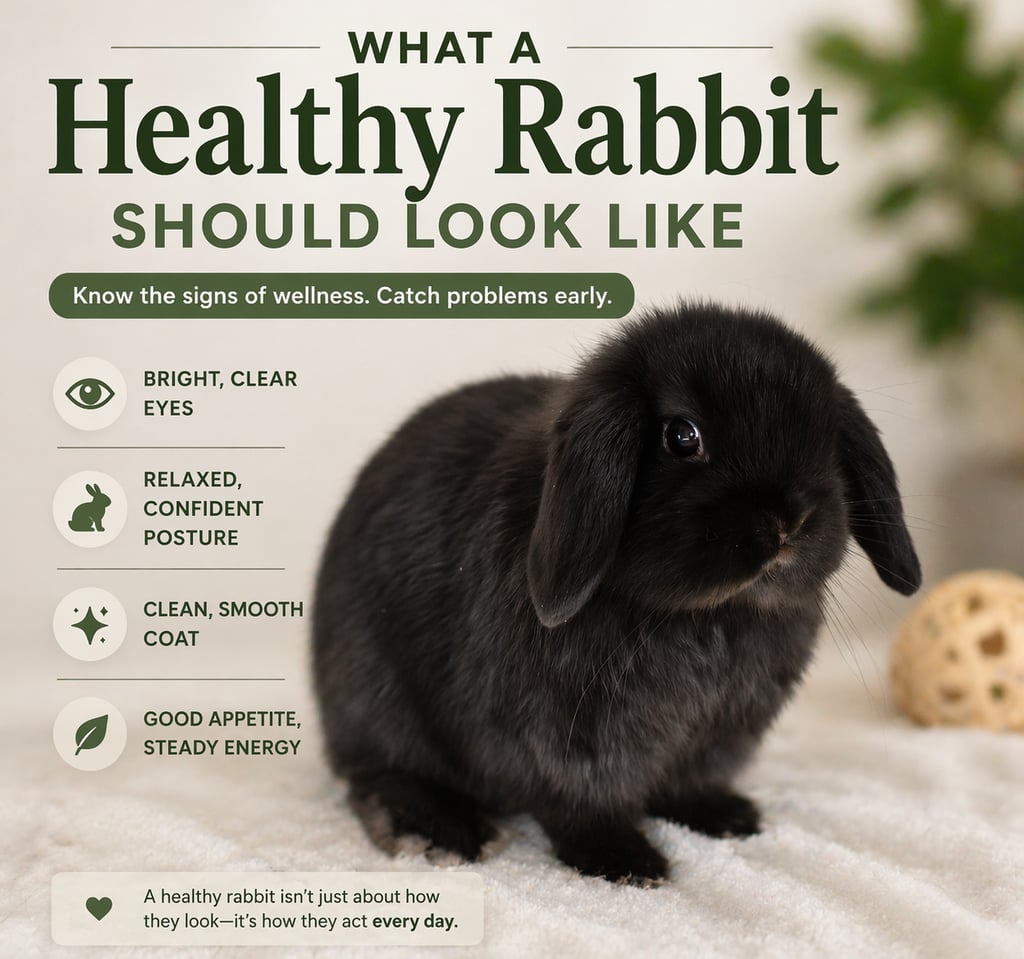
A relaxed body posture, whether sitting upright or resting fully stretched out
Smooth, even breathing that is barely noticeable
Bright, clear eyes without discharge
A clean nose and dry chin
A soft, well-kept coat that lies naturally without patches or dullness (NOTE: As a rabbit approaches a molt, the coat will get duller and wisps of fur will poke out. This is normal.)
Regular eating habits, especially consistent hay consumption
Normal droppings that are round, firm, and fairly uniform in size
A healthy rabbit is not constantly “on.” It rests often, explores in short bursts, and returns to a place where it feels secure.
This is normal.
Subtlety is one of the defining characteristics of rabbit health.
Why It Matters (The Part People Miss)
One of the most common misunderstandings is assuming that a rabbit is healthy as long as nothing looks dramatically wrong.
Rabbits are prey animals. They are wired to hide discomfort for as long as possible. By the time obvious symptoms appear, something has often been developing beneath the surface for a while.
This is why learning the baseline matters more than memorizing symptoms.
When you understand what your rabbit looks like when it is well, you can recognize even small shifts. A slightly different posture, a hesitation around food, or a change in energy level can be meaningful.
This connects closely to understanding early warning signs, which is explored more deeply in How to Tell If a Rabbit Is in Pain, where those subtle behavioral changes become easier to recognize.
Long-term wellbeing depends on catching changes early, not reacting late.
What To Do (Practical, Real-World Guidance)
You do not need complicated routines to monitor your rabbit’s health. You need consistent observation.
Here is what that looks like in daily life:
Watch eating habits closely. A healthy rabbit returns to hay throughout the day without prompting.
Notice posture and movement. A rabbit that moves comfortably and settles easily is usually feeling well.
Check the environment. Clean, dry living spaces support health more than most people realize. If you are unsure about setup, What Makes a Great Rabbit Home? Creating a Safe, Happy Environment can help you evaluate your space.
Pay attention during quiet moments. Health is easiest to assess when the rabbit is resting, not when it is distracted.
Handle gently, when appropriate. Feeling along the body can help you notice weight changes or tension, especially as part of understanding How Much Space Does a Rabbit Really Need?, since movement and space directly affect physical condition.
Rabbit care is not about constant intervention, but steady awareness.
Rabbit wisdom: the small, consistent details tell you more than occasional checks ever will.
What To Watch For
Changes in a rabbit are often gradual, not sudden. The goal is not to become anxious, but to become attentive.
Watch for:
A decrease in appetite, especially reduced interest in hay
Smaller, misshapen, or fewer droppings
Sitting hunched instead of relaxed
Less movement or reluctance to explore
Changes in grooming habits or coat condition
Subtle shifts in personality, such as withdrawal or irritability
A gentle reminder: one small change does not always mean something serious. Patterns are what matter.
If something feels off and does not return to normal within a short period, it is worth paying closer attention and, when needed, involving a rabbit-savvy veterinarian.
Health is not a single moment. It's a pattern over time.
Closing
A healthy rabbit does not demand attention to prove that it is well.
It shows you quietly, in the way it rests, eats, moves, and settles into its space. When you learn to recognize those patterns, you begin to understand your rabbit in a deeper, more grounded way.
That understanding is what allows you to respond early, care well, and support a life that is steady, comfortable, and secure.
You May Also Find Helpful
As you continue learning what is normal, these articles can help you see the bigger picture of daily care and behavior:
Copyright 2016-present. All rights reserved by Hot Cross Buns Holland Lops. All images and content fall under the sole ownership of Hot Cross Buns Holland Lops.
Hot Cross Buns Holland Lops
Oberlin, Ohio
Indoor companion Holland Lops raised with care since 2016.
Email: hcbhollands@gmail.com