How to Tell If a Rabbit Is in Pain
How to tell if a rabbit is in pain through subtle changes in appetite, posture, and behavior, including key warning signs that should not be ignored and when veterinary intervention is needed.
Amy Jackson & The Hot Cross buns
4/10/20263 min read
How to Tell If a Rabbit Is in Pain
Pain appears as change, not intensity
A rabbit rarely shows pain in an obvious or dramatic way.
What appears instead is a shift away from that rabbit’s normal pattern. The change is often gradual, and it can be mistaken for mood or preference if it is not recognized early.
The most reliable way to identify pain is to notice when behavior, posture, or routine no longer matches what is typical for that individual rabbit.
A change in eating is often the first sign
A healthy rabbit eats with consistency.
The rabbit returns to hay throughout the day, approaches food without hesitation, and responds predictably to routine feeding. When that pattern changes, there is usually an underlying reason.
Pain often affects appetite early. The rabbit may hesitate, eat more slowly, or leave food unfinished. In some cases, he approaches food but does not follow through.
A rabbit that shows interest in food but does not eat is often experiencing discomfort.
Posture and stillness reveal more than movement
A rabbit in pain often limits how the body is used.
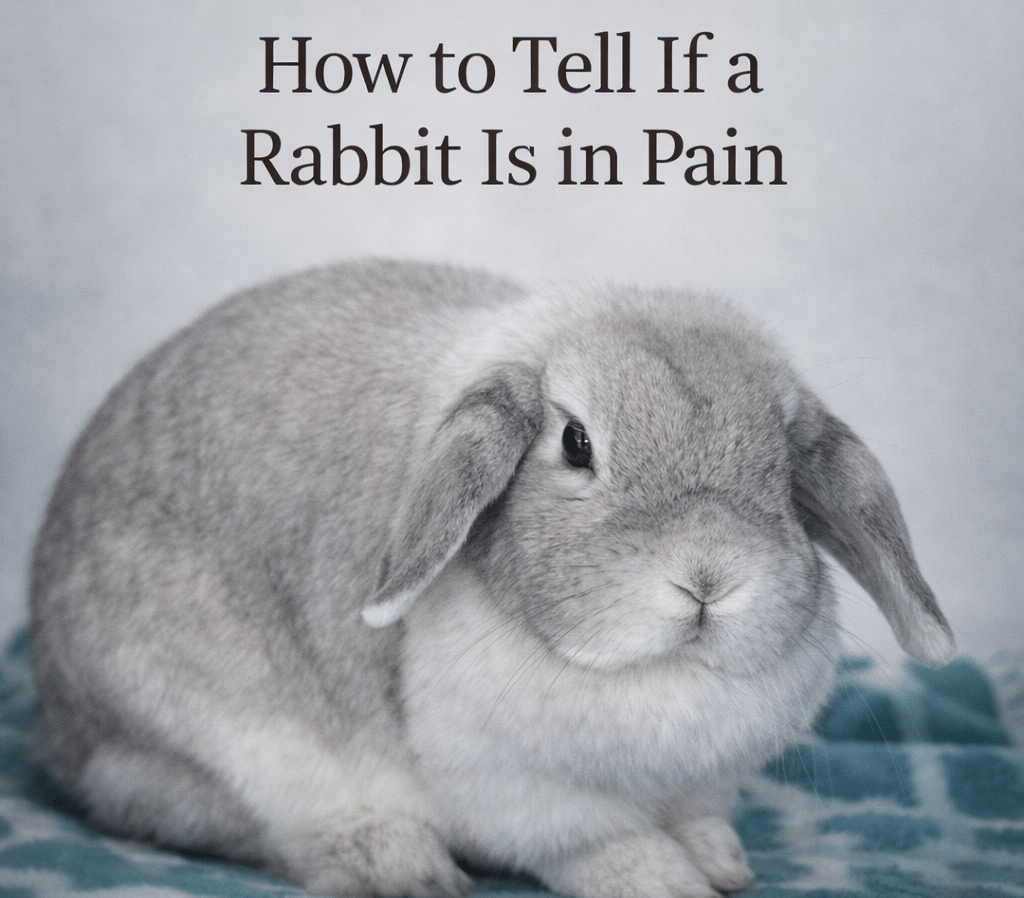
Instead of stretching out or shifting comfortably, the rabbit may remain in a compact position, with the abdomen held in and his body appearing contained rather than relaxed.
Stillness becomes more noticeable as well.
A comfortable rabbit shifts position, stretches, and adjusts naturally. A rabbit in pain often remains still for longer periods because movement increases discomfort.
Recognizable signs that should not be dismissed
Some indicators of pain are specific enough that they should immediately draw attention, even if everything else seems subtle.
Tooth grinding that is loud or harsh
Soft, quiet tooth purring can indicate comfort. Louder, more pronounced grinding is often associated with pain and should not be ignored.A hunched posture that does not relax
A rabbit that remains tightly tucked for extended periods is often trying to manage discomfort.Eyes that appear narrowed or dull
A rabbit in pain may look less alert, with a change in expression that feels subdued or guarded.Ears held back in a sustained way
Momentary ear movement is normal. A prolonged, flattened position often reflects tension.Reduced or absent droppings
Changes in output are closely tied to discomfort and digestive slowdown.
These signs do not need to appear all at once.
Even one, when paired with a change in normal behavior, is enough to take seriously.
Engagement with the environment decreases
A rabbit that feels well maintains a consistent level of interaction with the environment.
The rabbit explores, responds to familiar sounds, and reacts to routine activity. When pain is present, that level of engagement often decreases.
The rabbit may remain in one area, respond more slowly, or show less interest in surroundings. The change is often quiet, but it is noticeable over time.
Digestive changes follow quickly
A rabbit’s digestive system responds quickly to discomfort.
Reduced food intake leads to fewer droppings, but pain can also slow digestion directly. Droppings may become smaller, less frequent, or irregular in appearance.
This change develops alongside reduced appetite and altered posture.
A general change often appears first
There is often a stage where nothing appears clearly wrong, but the rabbit is not behaving normally.
The rabbit may eat less, move less, or interact differently without a single defining symptom. The change is noticeable when viewed as a whole.
This stage is often the earliest indication that something is wrong.
Pain does not resolve without a cause
A rabbit does not reduce eating or activity without a reason.
Waiting for improvement without identifying the cause allows the condition to progress. What begins as mild discomfort can become more serious, especially when digestion is affected.
When to seek veterinary care
A rabbit that shows changes in appetite, posture, behavior, or droppings should be evaluated by a rabbit-savvy veterinarian.
A rabbit that stops eating, produces little to no output, or appears consistently uncomfortable requires prompt attention.
A steady approach to observation
You do not need to identify every possible sign.
You need to recognize what is normal for your rabbit and notice when that pattern changes.
A gentle reminder
A rabbit does not express pain clearly.
The signs appear in small, consistent changes.
Recognizing those changes is one of the most important parts of responsible care.
___________________________________________________________________________________
For additional reading...
Copyright 2016-present. All rights reserved by Hot Cross Buns Holland Lops. All images and content fall under the sole ownership of Hot Cross Buns Holland Lops.
Hot Cross Buns Holland Lops
Oberlin, Ohio
Indoor companion Holland Lops raised with care since 2016.
Email: hcbhollands@gmail.com