
Why Spaying and Neutering Rabbits Is Essential
Why spaying and neutering rabbits is essential for health, behavior, and longevity, supported by veterinary research and real-world evidence. Hot Cross Buns only places rabbits with families who will have their rabbits altered by a knowledgeable rabbit veterinarian
Amy Jackson & The Hot Cross Buns
4/9/20263 min read
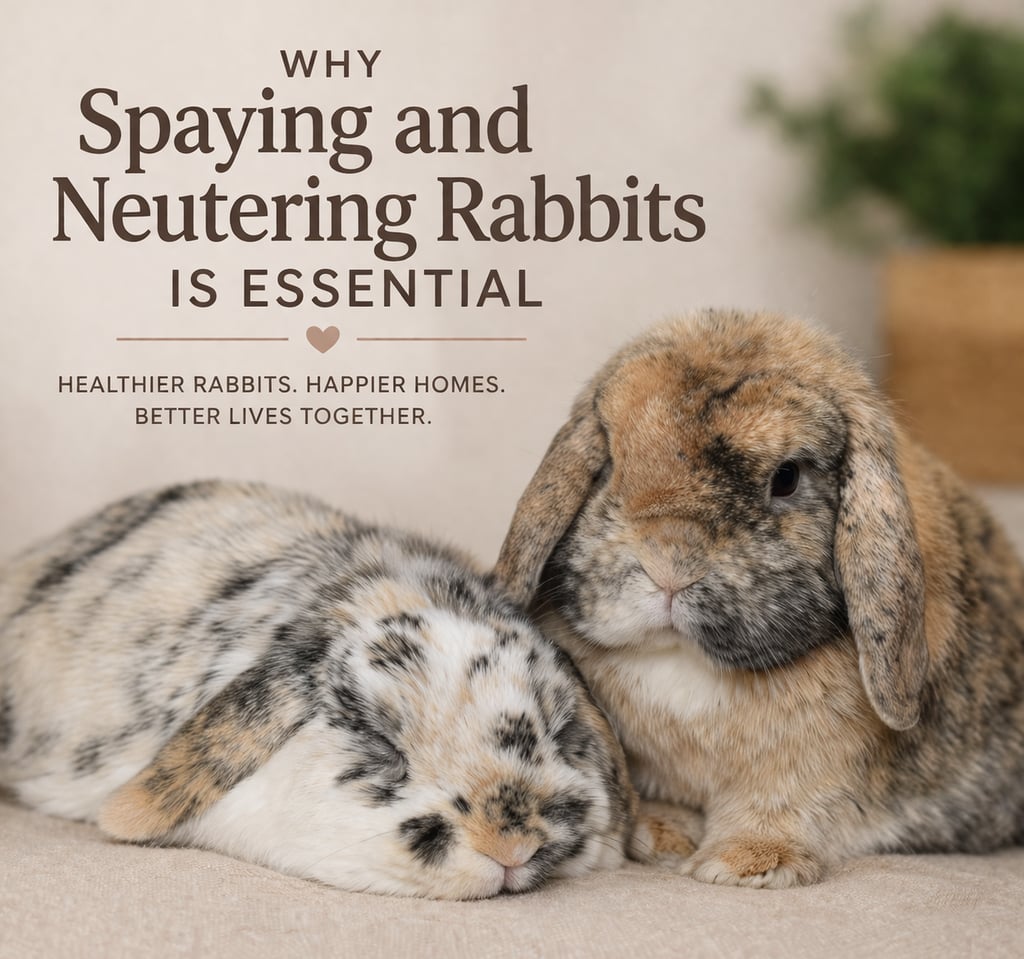
Why Spaying and Neutering Rabbits Is Essential
A decision grounded in evidence, not preference
Spaying and neutering is often discussed as a recommendation.
In reality, it is one of the most well-supported decisions in rabbit care, both clinically and through long-term observation. The risks associated with leaving rabbits unaltered are not subtle, and they are not uncommon.
This is not a matter of opinion.
It is a matter of documented outcomes.
The documented risk of reproductive disease
For female rabbits, the risk of reproductive disease is significant.
Multiple veterinary sources and studies report that a large percentage of intact does develop uterine disease, most commonly uterine adenocarcinoma, as they age. Estimates commonly fall between 60% and over 80%, depending on the population studied and age range.
Research has shown that these changes often develop without clear early signs and may not be detected until the disease is advanced. The risk increases steadily with age.
Spaying removes the uterus and ovaries.
It removes the risk.
In both males and females, leaving the reproductive system intact also increases the likelihood of infections and other complications that are preventable.
These are not rare outcomes.
They are patterns seen repeatedly over time.
These are not rare or theoretical conditions
Large-scale observational data reinforces this pattern.
In studies evaluating tumors in pet rabbits, reproductive tumors are consistently among the most common findings. This aligns with what experienced veterinarians report in practice.
Reproductive disease is not an exception.
It is expected in unaltered rabbits that live long enough.
Behavior is not separate from biology
Hormones influence how a rabbit experiences their environment.
Unaltered rabbits are more likely to mark territory, react strongly to perceived intrusions, and struggle with consistent litter habits. Mounting, spraying, and heightened reactivity are not personality traits in these cases, but are biologically driven behaviors.
Spaying or neutering does not change who a rabbit is.
It removes the constant hormonal influence that can override the natural temperament.
What remains is a rabbit whose behavior is more stable, more predictable, and easier to understand.
Companionship depends on hormonal stability
If a rabbit will ever share space with another rabbit, spaying or neutering is essential.
Bonding relies on calm, stable behavior. Hormones disrupt that stability. Even rabbits that are otherwise compatible can become reactive or territorial when hormonal influence is present.
A successful pairing is built on neutrality and ease.
That cannot be achieved while hormones are active.
Leaving a rabbit unaltered does not reduce risk
Leaving a rabbit unaltered is sometimes framed as a more natural choice.
In practice, it exposes the rabbit to well-documented risks that can be prevented entirely through spaying or neutering.
A clear standard of care
Veterinary organizations consistently recommend that pet rabbits who are not part of a responsible breeding program be spayed or neutered once they are mature enough for the procedure, typically at six months of age.
This recommendation exists because of what has been consistently observed—not because of preference.
At Hot Cross Buns, all rabbits placed as companions are expected to be spayed or neutered within an appropriate timeframe.
This is not presented as optional, but is part of ensuring that each rabbit is able to live a stable, healthy life in the home they are placed into.
A steady, long-term perspective
Spaying and neutering is a single decision with long-term impact.
It prevents conditions that are difficult to treat later. It supports behavior that is easier to live with and understand. It allows for safe companionship where appropriate.
Most importantly, it supports a longer, more stable life within a home environment.
A gentle reminder
Rabbits rely on the decisions made for them.
Choosing to spay or neuter is one of the most important ways to support their long-term wellbeing.
It is not about convenience.
It is about responsibility.
References
Mäkitaipale et al., 2022 – Histopathological uterine changes in rabbits
Settai et al., 2020 – Prevalence of uterine adenocarcinoma
Pornsukarom et al., 2023 – Tumor prevalence in pet rabbits
Veterinary consensus reports on uterine cancer risk (commonly cited 60–80%+)
House Rabbit Society – spay/neuter health guidance
BSAVA (British Small Animal Veterinary Association) – neutering recommendations
Oxbow Animal Health – behavioral and health impacts
For Additional Reading
If you would like to understand how this decision fits into everyday care and long-term planning, these articles expand on related topics:
Prepare Your Rabbit for Spay or Neuter Surgery | What Rabbit Owners Should Know
Rabbit Surgery Recovery: What to Expect After Spaying and Neutering
Common Health Problems in Pet Rabbits: What I Wish Every Owner Understood
Why You Must Have a Rabbit-Savvy Veterinarian Before an Emergency
How Long Do Rabbits Live? A Realistic Look at Lifespan and Commitment
Copyright 2016-present. All rights reserved by Hot Cross Buns Holland Lops. All images and content fall under the sole ownership of Hot Cross Buns Holland Lops.
Hot Cross Buns Holland Lops
Oberlin, Ohio
Indoor companion Holland Lops raised with care since 2016.
Email: hcbhollands@gmail.com