
What Makes a Rabbit Feel Safe?
What makes a rabbit feel safe and able to truly relax in your home? Learn how environment, placement, routine, and daily interactions shape a rabbit’s sense of security and trust.
Amy Jackson & The Hot Cross Buns
4/21/20264 min read
What Makes a Rabbit Feel Safe?
A rabbit’s sense of safety shapes everything.
It affects how he eats, how he rests, how he interacts, and whether he is able to settle into the home as a calm, confident companion. When a rabbit does not feel safe, behaviors begin to shift in ways that are often misunderstood. When he does feel safe, he relaxes and everything becomes easier.
Safety is not created through a single item or setup. It is built through environment, placement, and the quiet consistency of daily life.
What Safety Looks Like to a Rabbit
Rabbits are prey animals. Their instincts are built around awareness, escape, and the ability to retreat when needed. A space that feels open and welcoming to us often leaves them feeling vulnerable.
A rabbit who feels safe will begin to show it in small, steady ways. He rests more deeply. He stretches out instead of staying tucked and ready to move. He eats without hesitation and moves through his space without constantly scanning.
A rabbit that does not feel safe tends to stay on edge. Movement is quick and reactive. Rest is light. Time is spent watching rather than relaxing.
The goal is not to force confidence, but to create conditions where it can grow naturally.
The Environment Matters More Than You Think
Where a rabbit lives within your home matters as much as what you provide.
Open, high-traffic areas in the middle of a room often feel overwhelming. Bedrooms can create a different problem, especially for lighter sleepers, since rabbits are typically active in the evening and early morning and can be surprisingly busy and noisy.
A rabbit does best in a space that feels anchored and protected. Corners, walls, and partially enclosed areas allow him to observe without feeling exposed. He should be part of the home, not tucked away and forgotten, but also not placed where constant movement keeps him on alert.
Visual boundaries make a difference. A pen pushed against a wall feels very different from one set out in the open with activity on all sides.
Other Pets Change Everything
Even calm, well-behaved dogs and cats change how a rabbit experiences a space.
To a rabbit, the presence of another animal—especially one larger than he is—can feel unpredictable. Quick movements, staring, circling, or even quiet observation can be interpreted as a threat.
For many rabbits, simply knowing another animal can access their space is enough to prevent true relaxation.
Safe setups require clear physical boundaries. Pens must be sturdy and secure, not something that can be bumped, leaned on, or pushed over. Interactions should never be assumed safe based on temperament alone.
Some rabbits learn to coexist peacefully with other pets over time. Some remain uneasy. The goal is not forced interaction, but reliable safety.
Children and Movement in the Home
Children bring energy, noise, and unpredictability, all of which can feel overwhelming to a rabbit.
This doesn't mean rabbits and children cannot share a home. It means the rabbit’s space must be respected as a protected area where he is not chased, cornered, or constantly handled.
Rabbits do best when interaction is calm, seated, and on the rabbit’s terms. Quick reaching, lifting, and following can quickly erode a sense of safety.
Teaching children to slow down, sit on the floor, and allow the rabbit to approach creates a very different experience for both.
Noise and Daily Activity
Rabbits are highly aware of sound.
Sudden, sharp noises—shouting, dropping objects, barking, loud music—can startle a rabbit into a constant state of alertness if they happen frequently.
A completely silent home is not necessary. In fact, rabbits often adjust well to steady, predictable background noise. What unsettles them is inconsistency and intensity.
A home with regular rhythm feels safer than one where noise levels change dramatically throughout the day.
Hides Are Not Optional
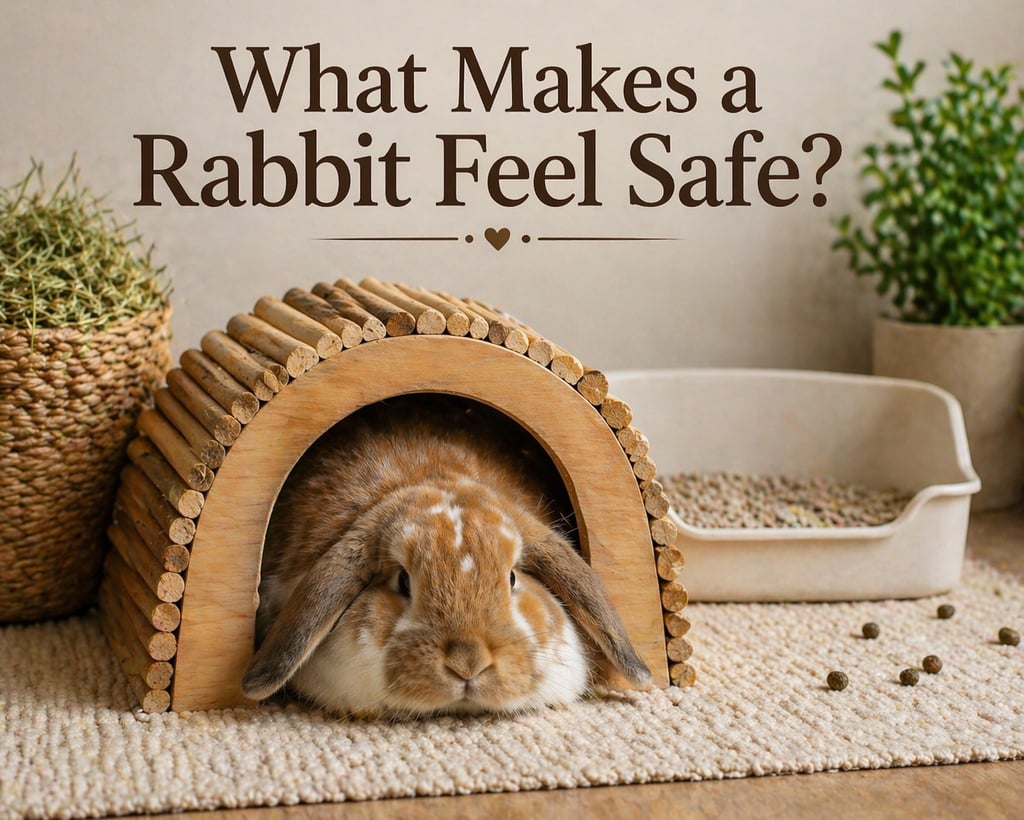
A rabbit needs a place to disappear.
This is not about shyness, but about control. A hide gives a rabbit the ability to step away, lower his guard, and rest without feeling watched.
Without that option, many rabbits stay in a state of low-level tension, even if they appear calm on the surface.
A good hide is:
Fully enclosed on at least two to three sides
Easy to enter and exit
Large enough for the rabbit to turn around comfortably
Many rabbits will choose to rest in or near their hide even after they have settled into the home. It remains a sort of security blanket for them.
Routine Builds Trust
Predictability is deeply reassuring to a rabbit.
Feeding at consistent times, approaching calmly, and maintaining a steady daily rhythm allows a rabbit to relax because he begins to know what is coming next.
Sudden changes, irregular schedules, and unpredictable handling keep a rabbit in a state of watchfulness.
Over time, a consistent routine teaches a rabbit that his environment is stable and safe.
Gentle, Respectful Interaction
Safety is not only about space. It is also about how a rabbit is handled and approached.
Reaching from above, picking up frequently, or moving too quickly can trigger instinctive fear responses. Even well-meaning interaction can feel overwhelming if it does not respect the rabbit’s perspective.
Trust grows when interaction feels predictable and calm.
Sit on the floor. Let him come closer. Allow curiosity to lead the interaction rather than forcing it. Over time, this creates a relationship where the rabbit chooses engagement instead of avoiding it.
What to Watch For
A rabbit will tell you when something feels off, though the signs are often subtle.
Watch for:
Staying tucked or pressed into corners
Reluctance to move freely in the space
Startling easily at normal household sounds
Avoiding interaction or retreating quickly
Resting lightly rather than stretching out
These are not personality flaws. They are information.
Adjusting the environment and slowing down interactions often leads to noticeable change.
What to Do
If your rabbit seems unsettled, begin with the basics.
Look at the placement of his space. Move it closer to a wall or into a quieter, more grounded area of the home. Add or improve hides so he has a reliable place to retreat.
Make sure hay, water, and the litter box are easily accessible and part of a calm, consistent setup.
Then look at your routine. Keep feeding and interaction predictable. Slow the pace of how you move around him. Give him time to observe without pressure.
These changes are simple, but they are powerful.
Safety is not something a rabbit is told. It is something he feels, gradually, through repeated experience. When that sense of safety is in place, everything else begins to fall into line.
________________________________________________________________________________________________________________
Additional suggested reading:
Copyright 2016-present. All rights reserved by Hot Cross Buns Holland Lops. All images and content fall under the sole ownership of Hot Cross Buns Holland Lops.
Hot Cross Buns Holland Lops
Oberlin, Ohio
Indoor companion Holland Lops raised with care since 2016.
Email: hcbhollands@gmail.com