
Why Do Rabbits Spray?
Why do rabbits spray urine? Learn why unneutered bucks spray, how hormones and courtship behaviors are involved, and how spaying or neutering helps prevent this messy habit.
Amy Jackson & The Hot Cross Buns
5/21/20262 min read
Why Do Rabbits Spray?
When It Starts
Spraying is one of those behaviors that tends to catch people off guard.
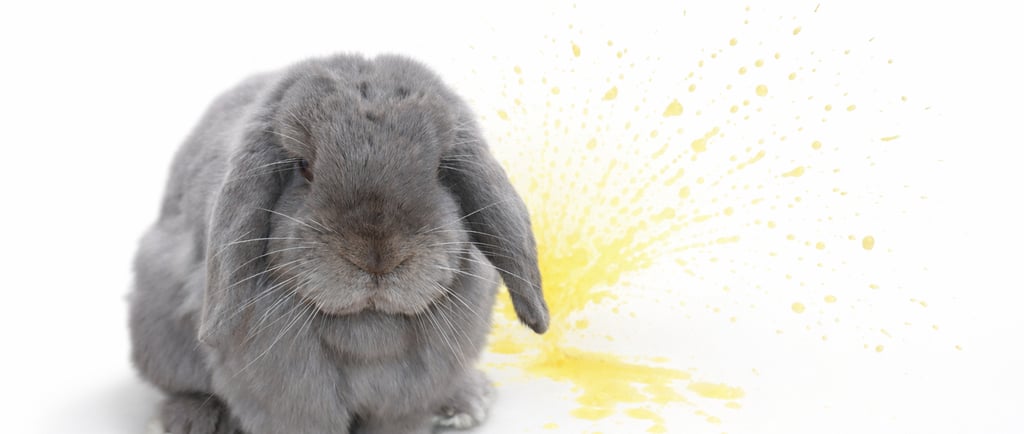
It's not subtle. A rabbit will lift slightly, flick the hind end, and send a stream of urine outward—sometimes onto nearby surfaces, and sometimes onto you.
It's messy, and it is not something most people expect from a rabbit. Being sprayed in the face is not fun.
A Hormonal Behavior
Spraying is most common in unneutered bucks.
It is a form of communication—a way of signaling to nearby does that he is available for breeding. The behavior is driven by hormones and tends to appear as a rabbit matures, usually between six and twelve months of age.
Does can spray as well, although it is less common. When they do, it is usually tied to hormonal changes or periods of receptivity.
In both cases, the behavior is not random, but has a clear biological purpose.
What It Often Comes With
Spraying rarely happens on its own.
It is often paired with other courtship behaviors such as circling, buzzing or honking, and mounting. When you see these behaviors together, it becomes clear that the rabbit is responding to hormonal drive rather than acting out or misbehaving.
The behavior may seem to appear suddenly, but it follows a predictable pattern as the rabbit reaches maturity.
Why It Becomes a Problem
In a home setting, spraying has no real purpose.
Instead, it becomes a habit that is difficult to live with. It can affect flooring, furniture, walls, and clothing. The odor can be strong, and repeated spraying can make cleaning a constant task.
Because of this, spraying is one of the more common reasons bucks are rehomed.
It's not a personality issue, but a hormonal one.
Preventing and Reducing Spraying
The most effective way to address spraying is through spaying or neutering.
For bucks, neutering at around six months of age is typically recommended. While some may not begin spraying until a bit later, addressing it early often prevents the behavior from developing at all.
If spraying has already started, neutering usually reduces or eliminates it over time.
Spaying does has a similar effect when hormonal behavior is the cause.
A Behavior With a Clear Cause
Spraying can feel frustrating, especially when it begins unexpectedly.
Understanding where it comes from makes it easier to respond appropriately. This is not a rabbit being difficult or poorly trained. It's a normal behavior appearing in the wrong environment.
With proper care, it is also one of the most preventable.
Copyright 2016-present. All rights reserved by Hot Cross Buns Holland Lops. All images and content fall under the sole ownership of Hot Cross Buns Holland Lops.
Hot Cross Buns Holland Lops
Oberlin, Ohio
Indoor companion Holland Lops raised with care since 2016.
Email: hcbhollands@gmail.com