
Building a Rabbit Emergency Kit
What should be in a rabbit emergency kit? Learn the essential supplies every rabbit owner should have to handle illness or injury while getting your rabbit to a vet.
Amy Jackson & The Hot Cross Buns
6/9/20263 min read
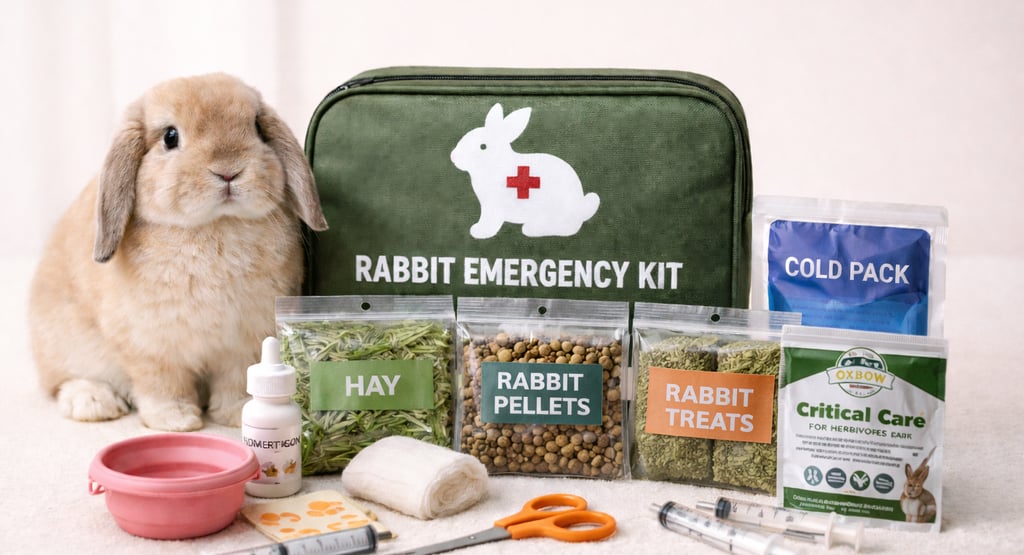
Building a Rabbit Emergency Care Kit
There is a phrase you will hear often in rabbit care:
“When in doubt, go to the vet.”
That remains true.
An emergency kit is not a replacement for veterinary care. It's simply a way to buy time—to keep your rabbit stable and supported until you can reach a rabbit-savvy veterinarian.
Often, that time matters more than anything else.
Why Preparation Matters
Rabbits rarely become ill at convenient times.
It happens late at night, during a holiday weekend, when your regular veterinarian is on vacation. Because not all emergency clinics are equipped to treat rabbits, delays can happen.
Having a kit ready means you are not scrambling while your rabbit is already in distress.
It allows you to act calmly, instead of react urgently.
Start With the Essentials
You don’t need everything all at once.
A well-prepared emergency kit can grow over time, but there are a few items that are worth having on hand from the beginning.
Basic Medical Supplies
Digital thermometer (normal range: 101–103°F)
Water-based lubricant (for temperature checks)
Gauze pads, cotton balls, Q-tips
Self-adherent bandage (VetWrap or similar)
Styptic powder or cornstarch (for nail bleeds)
Blunt scissors and tweezers
Saline solution or eyewash
Oral syringes (1 mL for medications, larger for feeding)
These are your foundational tools—the things you may reach for quickly.
Support for Appetite and Digestion
If there is one category not to skip, it is this one.
Recovery food (such as EmerAid Sustain Herbivore, Critical Care, Appetite Restore from Sherwood)
Feeding syringes (larger catheter-tip style)
Simethicone (infant gas drops)
Plain canned pumpkin (not pie filling)
a bottle of clear Pedialyte or Gatorade (not the Zero Sugar type)
Rabbits who stop eating can decline quickly. Having these items ready allows you to respond immediately while arranging veterinary care.
When Your Rabbit Has a History of GI Stasis
If your rabbit has experienced GI stasis and has been treated by your veterinarian multiple times, it may be worth having a conversation about being better prepared.
In some cases, your veterinarian may be willing to prescribe a small supply of pain medication (commonly meloxicam/Metacam) to keep on hand for emergencies.
If this is approved, ask for:
a syringe clearly marked with the correct dosage for your rabbit’s weight
written instructions outlining when and how the medication should be given
Pain management can make a significant difference in whether a rabbit is willing to eat, which directly impacts gut movement.
A rabbit in pain will not eat, and a rabbit who does not eat can decline quickly.
This is not something to use independently or without guidance. It should only be used according to your veterinarian’s instructions as part of a plan you have already discussed together.
Temperature and Comfort Support
Heating pad or warming disc
Ice packs or frozen water bottles
Towels or blankets
Temperature support should always be based on an actual reading—not guesswork. Warming or cooling a rabbit incorrectly can make a situation worse.
Wound Care
Hydrogen peroxide (for cleaning fur or checking for blood)
Pet-safe antimicrobial spray (such as Vetericyn)
Plain antibiotic ointment (no added pain relief)
Rabbit skin is delicate. Gentle care is essential, and anything beyond minor wounds should be seen by a veterinarian.
Practical Items You Will Be Glad You Have
Small flashlight
Hand sanitizer and gloves
Washcloths
Nail clippers
These are easy to overlook, but incredibly useful when you need them.
The Most Important Item Isn’t in the Kit
Your carrier.
It should be easy to access, clean, and ready to go at all times. In an emergency, you don’t want to be searching for it or trying to make something else work.
A towel lining the bottom helps prevent slipping and keeps your rabbit secure during transport.
Veterinary Contact Information
Have this written down—not just saved in your phone.
Include:
your regular veterinarian
the nearest emergency clinic that treats rabbits
When something is wrong, you don’t want to be searching for numbers.
A Calm, Practical Approach
An emergency kit is not about preparing for everything.
It’s about being ready for the first steps:
stabilizing
observing
supporting
and getting help as quickly as possible
Most of these items will sit unused for long periods of time, so check expiration dates from time to time.
Copyright 2016-present. All rights reserved by Hot Cross Buns Holland Lops. All images and content fall under the sole ownership of Hot Cross Buns Holland Lops.
Hot Cross Buns Holland Lops
Oberlin, Ohio
Indoor companion Holland Lops raised with care since 2016.
Email: hcbhollands@gmail.com