
Why Is My Rabbit Digging on Me?
Why is my rabbit digging on me? Learn what this behavior means, when it’s instinct or communication, and how to protect yourself from scratches and accidental nips.
Amy Jackson & The Hot Cross Buns
6/8/20262 min read

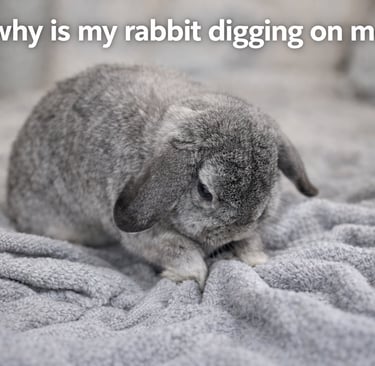
Why Is My Rabbit Digging on Me?
When It Happens
It usually starts suddenly.
You’re sitting with your rabbit—petting, relaxing, everything seems calm—and then the digging begins. Front paws working quickly, sometimes with surprising force, as your rabbit scratches at your clothes, your lap, or your arms.
It can feel confusing, and sometimes a little painful.
What the Behavior Means
Digging is a natural rabbit behavior.
In the wild, rabbits dig to create burrows, adjust their space, and make themselves comfortable. That instinct doesn’t disappear just because they live in a home.
When your rabbit digs on you, they are not trying to hurt you. They are usually responding to an urge to:
rearrange their environment
create a comfortable resting spot
or change something that doesn’t feel quite right
You just happen to be where they’ve decided to work.
When It’s About Communication
Sometimes digging is less about instinct and more about communication.
A rabbit may dig on you when:
they want attention
they want you to move
they’re done being held or petted
they’re trying to initiate play
It’s often paired with a shift in energy—more alert, more insistent, less relaxed than before.
In that context, digging is a clear signal:
👉 “Something needs to change.”
When Hormones Play a Role
In some rabbits, especially those who are not yet spayed or neutered, digging can be tied to hormonal behavior. This is especially true of does who dig and rearrange in the same manner they would use to prepare a nest for a litter of kits.
It may appear alongside:
circling
buzzing or honking
mounting
In those cases, the behavior can feel more intense or persistent. Addressing the hormonal component often reduces it significantly.
Why It Can Hurt (and How to Protect Yourself)
Rabbit front paws are stronger than they look.
Their nails are designed for digging, and even light scratching can leave marks or catch on clothing. Digging is also often accompanied by the use of their teeth to grip, pull, or rearrange whatever is under them.
This is not biting in an aggressive sense—it’s part of how they interact with their environment—but it can still result in accidental nips.
If you have a persistent digger, it helps to add a layer of protection. A thick fleece blanket, comforter, or even a heavy hoodie between you and your rabbit can make a significant difference. It allows you to interact comfortably without reacting to every scratch or tug, which helps keep the interaction calm and consistent.
What to Do About It
The response depends on what your rabbit is trying to communicate.
If they are asking for space:
👉 let them move off or gently set them down
If they seem restless or energetic:
👉 redirect them to a safe digging outlet (blanket, towel, digging box)
If the behavior is persistent and hormonally driven:
👉 spaying or neutering is usually the most effective long-term solution
Avoid reacting dramatically. Pulling away quickly or making it into a game can reinforce the behavior.
When It Becomes Too Much
Most rabbits will outgrow digging on you once their needs are understood and met.
If the behavior is occasional, it’s usually just communication or restlessness. If it becomes frequent, forceful, or difficult to manage, it’s worth looking at what’s driving it.
Ask yourself:
Is your rabbit getting enough space and exercise?
Do they have appropriate outlets for digging?
Are hormones still playing a role?
When those needs are addressed, the behavior often settles on its own.
Copyright 2016-present. All rights reserved by Hot Cross Buns Holland Lops. All images and content fall under the sole ownership of Hot Cross Buns Holland Lops.
Hot Cross Buns Holland Lops
Oberlin, Ohio
Indoor companion Holland Lops raised with care since 2016.
Email: hcbhollands@gmail.com