Why We Don’t Place Pedigreed Rabbits
Do rabbits need pedigrees? Learn why we don’t place pedigreed rabbits, what pedigrees actually mean, and why most rabbits should remain beloved companions—not breeding animals.
Amy Jackson & The Hot Cross Buns
6/11/20262 min read
Why We Don’t Place Rabbits With Pedigrees
From time to time, we’re asked if our rabbits come with pedigrees.
It’s a fair question, but it often comes with an assumption—that a pedigree means a rabbit is higher quality, more valuable, or should be bred.
That assumption is where the problem begins.
A casually issued pedigree is not proof of quality
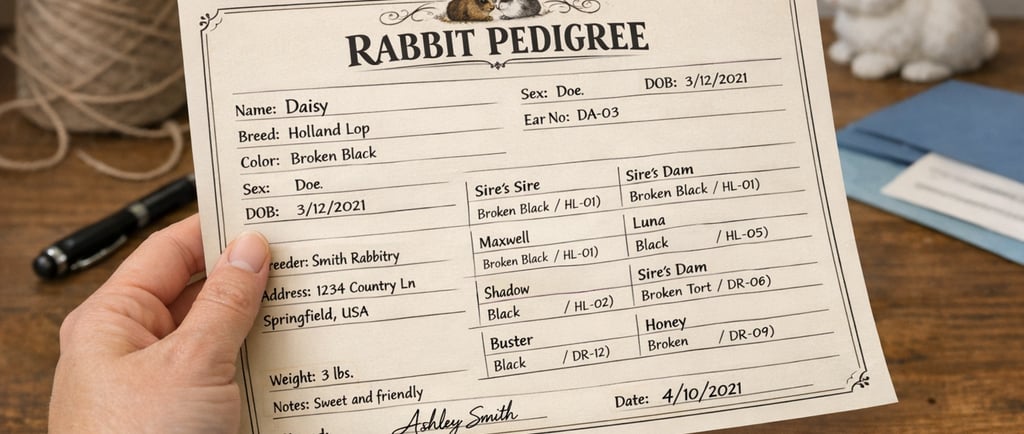
A pedigree is a record of ancestry. Nothing more.
It tells you who a rabbit comes from.
It does not tell you if that rabbit:
meets the breed standard
has correct type
should ever be used in a breeding program
Those are determined through evaluation—not paperwork.
In breeds like the Holland Lop, proper type is specific and unforgiving. Head, crown, ear placement, bone, depth, balance—every piece matters.
And the truth is simple:
Very few rabbits— even in strong programs— actually meet that standard well enough to be bred.
Most do not.
That’s not a failure. It's normal.
We do not place breeding stock
Let’s be very clear:
Every rabbit we place is a companion animal.
Even those who come closest to the Standard of Perfection set by the American Rabbit Breeders Association are not placed as breeding stock.
All are to be spayed or neutered at the appropriate age (typically 6–7 months).
Because breeding is not a casual extension of ownership.
It's a responsibility that requires experience, discipline, and a clear purpose for improving the breed.
Not every rabbit—and not every home—is meant for that.
What a pedigree is supposed to mean
A pedigree should not be automatic.
In a responsible program, it is a breeder’s endorsement that says:
“This rabbit has been evaluated, meets the standard in a meaningful way, and is worth considering in the future of the breed.”
That's a high bar, as it should be.
The reality most people don’t see
Even in well-bred litters:
Type changes as kits grow
Structure can fall off quickly between 8–16 weeks
Ears, crown, bone, density, and balance don’t always come together
Temperament and overall soundness matter just as much
So what actually happens?
Only a small percentage of rabbits rise to breeding quality.
The majority are exactly what they should be: excellent companions.
When everything is pedigreed, nothing is
If a breeder is sending every rabbit home with a pedigree, it’s worth asking why.
One of two things is happening:
The rabbits are not being critically evaluated
Or the pedigree is being used to increase perceived value
Either way, the pedigree stops meaning what it should.
It becomes paperwork, not proof.
Why we made this decision
We chose not to place rabbits with pedigrees because we will not attach that kind of implication to animals that are not meant to be bred.
Not because we don’t know our lines—we do.
Not because our rabbits lack quality—they don’t.
But because clarity matters.
We raise rabbits for indoor companion homes, and we intentionally protect them.
What we stand behind instead
We stand behind rabbits who:
are temperamentally sound
transition well into family life
are placed thoughtfully, based on fit—not who places a deposit first
Most families are not looking to breed, but are looking for a rabbit to love.
And that’s exactly why we raise them.
Copyright 2016-present. All rights reserved by Hot Cross Buns Holland Lops. All images and content fall under the sole ownership of Hot Cross Buns Holland Lops.
Hot Cross Buns Holland Lops
Oberlin, Ohio
Indoor companion Holland Lops raised with care since 2016.
Email: hcbhollands@gmail.com