
Splay Leg in Rabbits: Causes, Care, and What to Expect
What is splay leg in rabbits? Learn the causes, symptoms, and care needs for rabbits with splayed legs, including how to support mobility and when to seek veterinary help.
Amy Jackson & The Hot Cross Buns
6/16/20263 min read

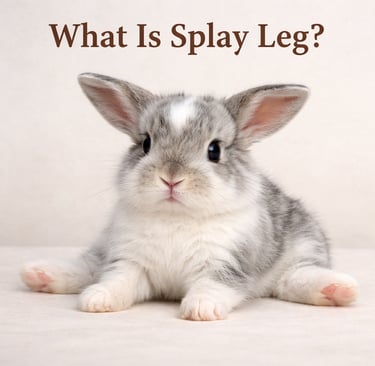
What Is Splay Leg in Rabbits?
If you’ve ever seen a rabbit whose legs slide out to the side instead of staying underneath them, you may have come across a condition called splay leg.
It can look alarming at first—but understanding what’s happening helps you respond appropriately and compassionately.
What splay leg actually is
Splay leg (sometimes called “spraddle leg”) is a condition where one or more of a rabbit’s legs extend outward rather than staying positioned underneath the body.
Instead of being able to hop normally, the rabbit may:
slide or scoot instead of hopping
struggle to gain traction
have difficulty standing upright
It most often affects the back legs, but in some cases, the front legs can be involved as well.
A rabbit we will never forget
One of the most beloved bucks ever born here at Hot Cross Buns was a beautiful broken chinchilla named Gideon.
Gideon was born with congenital defects. His front feet turned inward, and his hind paws turned outward—almost forming an L-shape. From the beginning, his movement was different.
Gideon never seemed to notice that he was different.
He was the happiest, most contented rabbit—truly a ray of sunshine. There was a welcoming the world with joy and sweetness about him that made him unforgettable. He didn’t just live his life… he filled it with quiet joy.
He had his own way of doing binkies and zoomies that melted our hearts.
In time, we placed him as a bonding companion for Blackberry, one of our does who had overcome a severe case of Encephalitozoon cuniculi.
They adored each other.
His family cared for him beautifully, and for a long time, he continued to do well. But as time passed, the strain of scooting and compensating for his condition began to take its toll.
He began to struggle—with grooming, with accidents, and eventually with discomfort.
When it became clear that he was experiencing pain, the decision was made to let him go peacefully.
It was not an easy decision, but it was the right one.
Gideon’s life was shorter than we had hoped—but it was full. He loved deeply, trusted completely, and brought more joy than we could have imagined.
He will always hold a very special place in the hearts of those who knew and loved him.
What causes splay leg?
Splay leg is typically not something that develops later from normal handling or care.
In most cases, it is:
congenital (present from birth)
related to developmental issues with muscles, tendons, or joint alignment
Less commonly, it can be influenced by:
poor footing early in life (slippery surfaces)
weakness or injury in young kits
In well-managed environments, true splay leg is usually something a rabbit is born with.
Can rabbits with splay leg live normal lives?
They can live happy, cared-for lives, but they will need accommodations.
Rabbits with splay leg are not able to move or function the same way as a typical rabbit. That means:
non-slip flooring (fleece, mats, or textured surfaces)
extra attention to cleanliness, especially around the hind end
possible difficulty with litter habits
increased risk of sore hocks or skin irritation
In more severe cases, mobility can be significantly limited.
Is there a treatment or cure?
There is no true “cure” for splay leg.
In very young kits, early intervention (such as gentle hobbling techniques under experienced guidance) can sometimes improve leg positioning—but results are not guaranteed.
For older rabbits, care focuses on:
support
comfort
quality of life
Not correction.
Should rabbits with splay leg be bred?
No.
Splay leg is generally considered a genetic or developmental fault, and rabbits with this condition should not be used in a breeding program.
Responsible breeders will:
remove affected rabbits from breeding plans
avoid repeating pairings that produced the condition
prioritize long-term soundness
What to do if you suspect splay leg
If you notice your rabbit struggling to keep their legs underneath them:
move them to a non-slip surface immediately
observe how they move (sliding vs. hopping)
consult a rabbit-savvy veterinarian for guidance
Early support can make a meaningful difference in comfort.
A gentle perspective
Rabbits with splay leg may move differently, but they are still capable of forming strong bonds, enjoying attention, and living meaningful lives with the right support.
They simply need a home that understands their limitations—and is willing to meet them where they are.
Copyright 2016-present. All rights reserved by Hot Cross Buns Holland Lops. All images and content fall under the sole ownership of Hot Cross Buns Holland Lops.
Hot Cross Buns Holland Lops
Oberlin, Ohio
Indoor companion Holland Lops raised with care since 2016.
Email: hcbhollands@gmail.com