
Why Do Rabbits Circle?
Why do rabbits circle your feet? Learn what circling behavior means, how hormones and mating instincts drive it, and what to do to manage or reduce this behavior safely.
Amy Jackson & The Hot Cross Buns
4/9/20252 min read
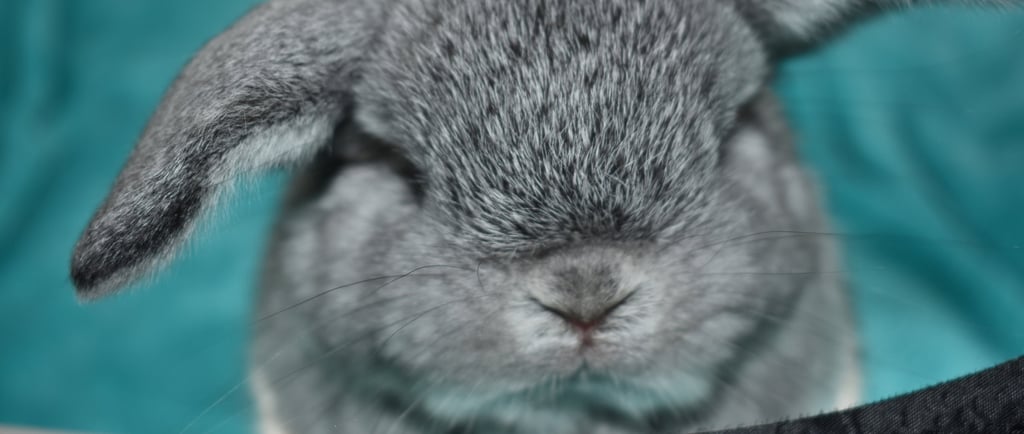
Why Do Rabbits Circle?
When the Behavior Starts
Rabbit circling often seems to appear out of nowhere.
One day, your rabbit is moving around normally, and the next, they are weaving quickly around your feet, darting in tight loops, and making it nearly impossible to walk without watching every step.
It can feel playful at first, but the intensity usually makes it clear that something else is going on.
A Hormonal Behavior
Circling is most often driven by hormones.
It's a courtship behavior, commonly seen in unspayed or unneutered rabbits as they reach maturity, often around four to six months of age. Bucks tend to display it more frequently, but does can show it as well.
When a rabbit circles, they are not simply playing. They are responding to a strong instinct to seek a mate.
This is why the behavior often appears suddenly and with persistence.
Why You Become the Target
In a home environment, there is usually no appropriate outlet for that instinct.
As a result, the behavior is directed toward whatever is available—often a person. Rabbits will circle your feet, follow you closely, and stay focused in a way that feels different from normal interaction.
If you also hear a low buzzing or honking sound, the meaning becomes even clearer.
You are being courted. You can read more about that behavior in our post: Why Do Rabbits Buzz or Honk?
What It Often Comes With
Circling rarely happens on its own.
It is often paired with mounting, and in some cases, spraying. When a rabbit attempts to mount a person’s foot, ankle, or arm, they may grip with their front paws to maintain balance. Because of this, nails can scratch, and in some cases, a rabbit may use his teeth briefly to steady himself.
These behaviors are all part of the same hormonal drive and tend to appear together as a rabbit matures.
The shift can feel sudden. What seems amusing at first can become frustrating once the behavior becomes persistent or more physical.
What Changes After Spay or Neuter
For most rabbits, circling decreases significantly after spaying or neutering.
The intensity drops, the persistence fades, and the behavior becomes much less frequent. In many cases, it disappears entirely.
This is one of the reasons spaying and neutering are so important—not only to prevent unwanted litters, but to reduce behaviors that can become stressful for both the rabbit and the household.
What to Do With the Behavior
Circling is not something you need to correct in the moment, but is something you should understand.
If your rabbit is circling your feet, move carefully and avoid reacting in a way that turns it into a game. Stepping over or around him without engaging usually keeps it from becoming more persistent.
What matters more is the bigger picture.
If circling is frequent, intense, or paired with mounting or spraying, it's a sign that hormones are driving the behavior. In those cases, spaying or neutering is the most effective way to reduce it.
Without that change, the behavior often continues or increases over time.
________________________________________
You may also find these helpful:
→ Why Do Rabbits Buzz or Honk?
→ Musings on Mounting
→ Why Do Rabbits Spray?
→ Rabbit Spay & Neuter: What 10 Years Has Taught Me
→ Available Buns
→ Before You Apply
Copyright 2016-present. All rights reserved by Hot Cross Buns Holland Lops. All images and content fall under the sole ownership of Hot Cross Buns Holland Lops.
Hot Cross Buns Holland Lops
Oberlin, Ohio
Indoor companion Holland Lops raised with care since 2016.
Email: hcbhollands@gmail.com